
Anna, Texas — Anna City Council spent Tuesday evening examining a proposed property tax increase, a $31.1 million General Fund budget and more than $100 million in capital investments as the city prepares for Fiscal Year 2027.
The Sept. 1 special meeting included discussions over the unfinished Rosamond Parkway, the long-awaited Ferguson Parkway project, expansion of the city’s wastewater system and the growing cost of maintaining city services.
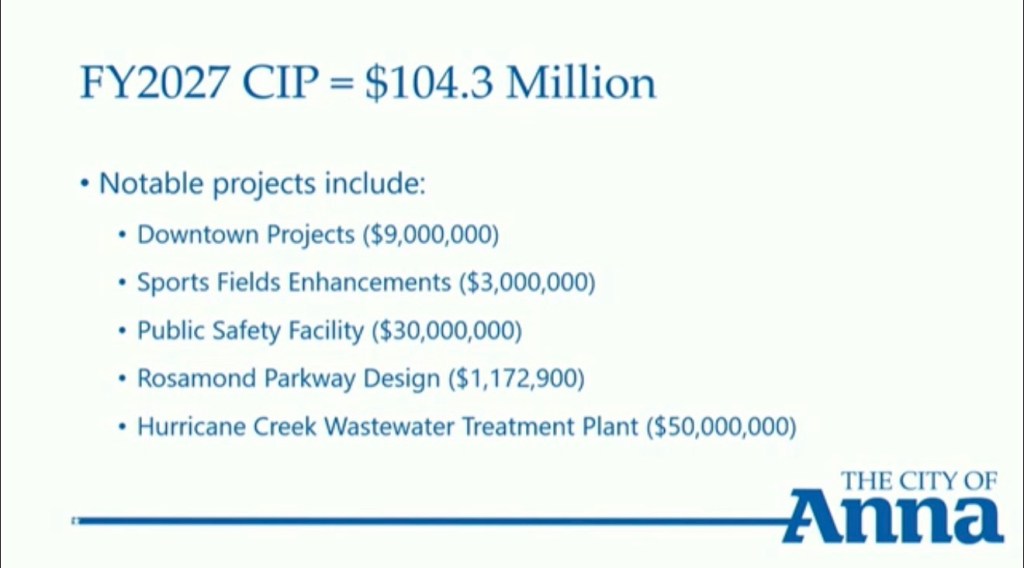
Major projects included in Anna’s proposed FY2027 Capital Improvement Program.
$104 Million in Capital Projects
Anna’s proposed FY2027 Capital Improvement Program totals approximately $104.3 million, including $50 million toward the Hurricane Creek Wastewater Treatment Plant, $30 million for a public safety facility, $9 million in downtown projects, $3 million for sports field enhancements and approximately $1.17 million for Rosamond Parkway design.
Rosamond Parkway has remained largely one lane in each direction between State Highway 5 and U.S. 75 for roughly six years. The city is designing additional lanes between Buddy Hayes Boulevard and State Highway 5, but construction remains incomplete.
Other sections are expected to be constructed by developers as adjoining properties develop.
“So for Rosamond, we’re not building all of that, right?” Mayor Pete Cain asked. “Some of that’s constructed in front of the retail that’s going up?”
“The retail development going up near 75 is building their two lanes portion, and then there’s a small development that’s right next to Highway 5 on the northwest corner that’s going to be building their section,” City Engineer Kevin Bates said.
The arrangement leaves portions of one of Anna’s primary east-west corridors tied to the timing of private development. Roughly six years after its original construction, Rosamond has yet to be paved to completion between Highway 5 and U.S. 75.
Toten Questions Ferguson Timeline
Councilmember Kevin Toten raised similar concerns over Ferguson Parkway, questioning why the long-discussed project remains years away from construction.
“Ferguson, why are we so far behind?” Toten asked. “I’ve been up here for eight years and that’s been a hot topic for eight years.”
“It’s not even our money funding this,” Toten added. “This is being funded by someone else and it’s not even going to start until 2029.”
Bates said the timeline could not necessarily be attributed to any one party.
“I don’t think you can necessarily blame one thing — development, TxDOT, City of Anna,” Bates said.
The project is estimated at approximately $48 million, with around $40 million expected from TxDOT. Bates said environmental assessments, route studies and other requirements associated with the TxDOT process contribute to the lengthy timeline.
Wastewater Expansion Raises Rate Concerns
Council also discussed continued expansion of the Hurricane Creek Wastewater Treatment Plant.
Toten questioned whether expansion could be slowed to limit pressure on utility rates.
“I’m trying to keep the rate from having to go up,” Toten said. “Can we slow the building of the wastewater treatment plant so we don’t have to hire nine and raise the rate so much?”
Bates said existing agreements with neighboring communities already require additional capacity, including two Van Alstyne connections expected to send one million gallons per day each.
Public Services Director Joseph Cotton said staffing requirements would begin once the facility reaches two million gallons per day.
“At two we have to staff it with nine,” Cotton said. “We have to go to 24-hour-a-day operations at two million gallons.”
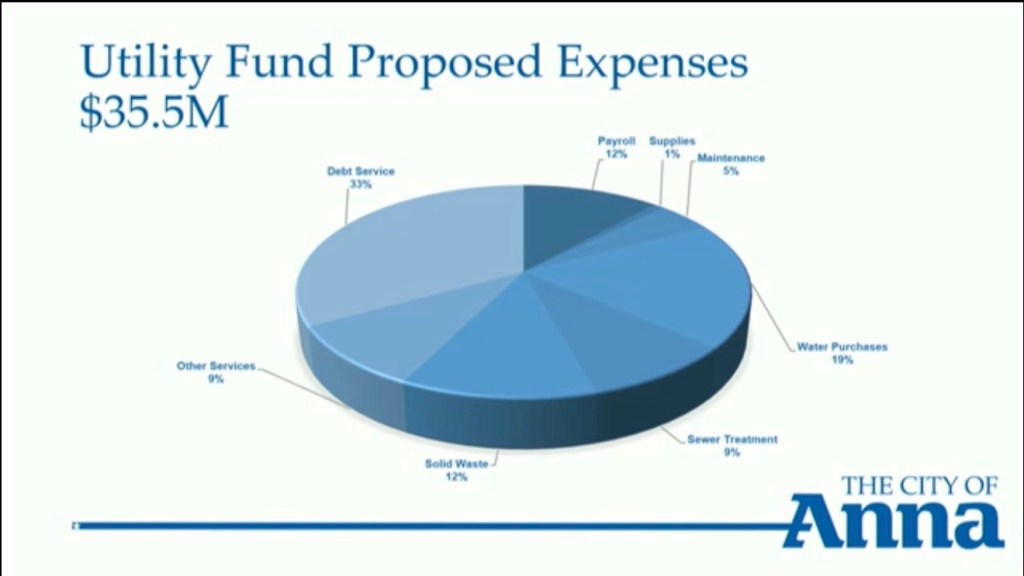
Bates said debt associated with the plant is also driving rates.
“The rate is driven by the debt service, the $54 million that was approved a month ago,” Bates said. “That is going into the rate, but also built into that rate model [is] the staffing of that plant.”
$31.1 Million General Fund Budget
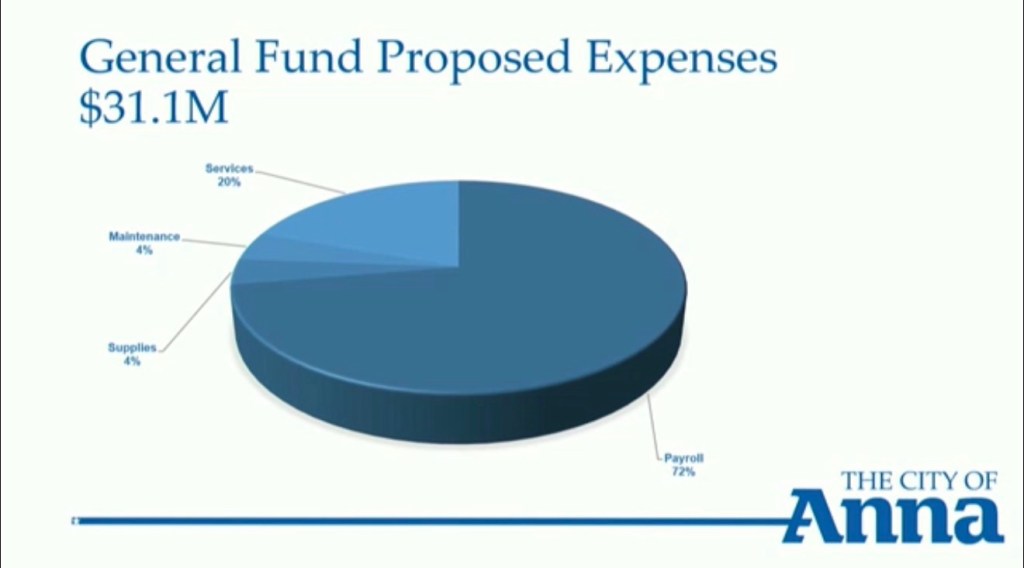
Finance Director Terri Doby presented a proposed $31.1 million General Fund budget, balanced with an equal amount in projected expenditures.
“This is local government. We don’t spend money we don’t have,” Doby said. “No deficit spending here.”
Payroll represents approximately 72% of General Fund expenses, with Doby saying at least two-thirds of that amount is associated with police and fire.
Councilmember Kelly Herndon questioned several figures within the budget, including projected interest revenue, a $21 million Utility Fund transfer for capital projects and approximately $8 million budgeted for computer hardware, software and equipment.
“What exactly are we buying with that?” Herndon asked.
“Eight million?” Doby responded while reviewing the budget. “I would have to look at the breakdown. I will look at that.”
Doby said the $21 million Utility Fund transfer consists of money accumulated over several years that can be used for non-bond capital work and major maintenance, including aging pipes and water-main breaks.
Property Tax Rate Would Rise
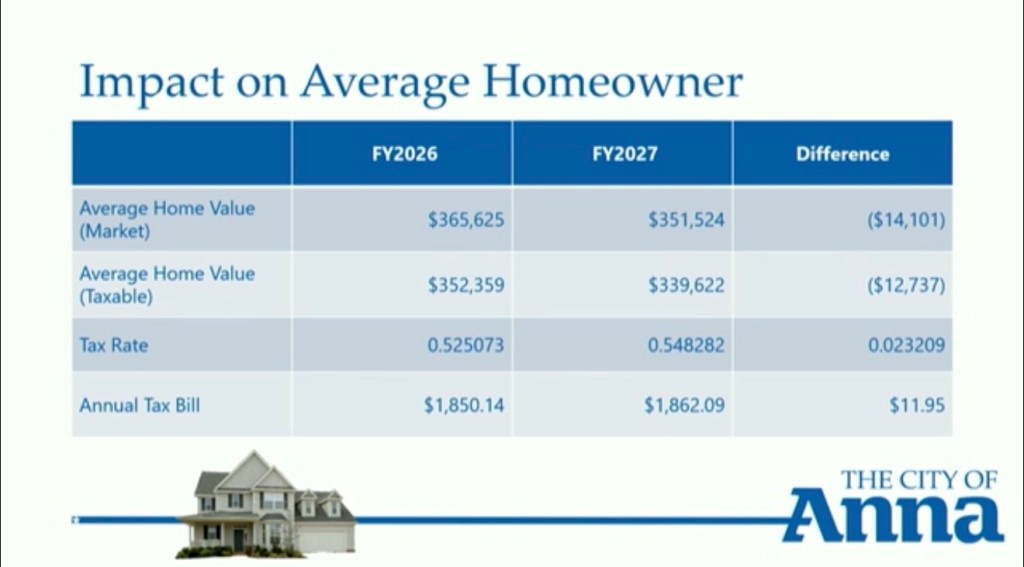
The city is proposing a property tax rate of $0.548282 per $100 of taxable valuation, up from $0.525073.
At the same time, the average taxable home value used by the city fell from $352,359 to $339,622.
Under the city’s calculations, the annual City of Anna property tax bill on the average home would rise from $1,850.14 to $1,862.09 — an increase of $11.95 per year.
Doby cautioned that the calculation does not represent every property owner.
“No one is average,” Doby said. “Everybody is either above or below this, so your mileage will vary as to what happens to your tax bill.”
The proposed rate represents an approximately 4.4% increase in the tax rate itself, though changes in individual taxable values will determine whether a homeowner’s actual city tax bill rises or falls.
Residents Question Burden on Homeowners
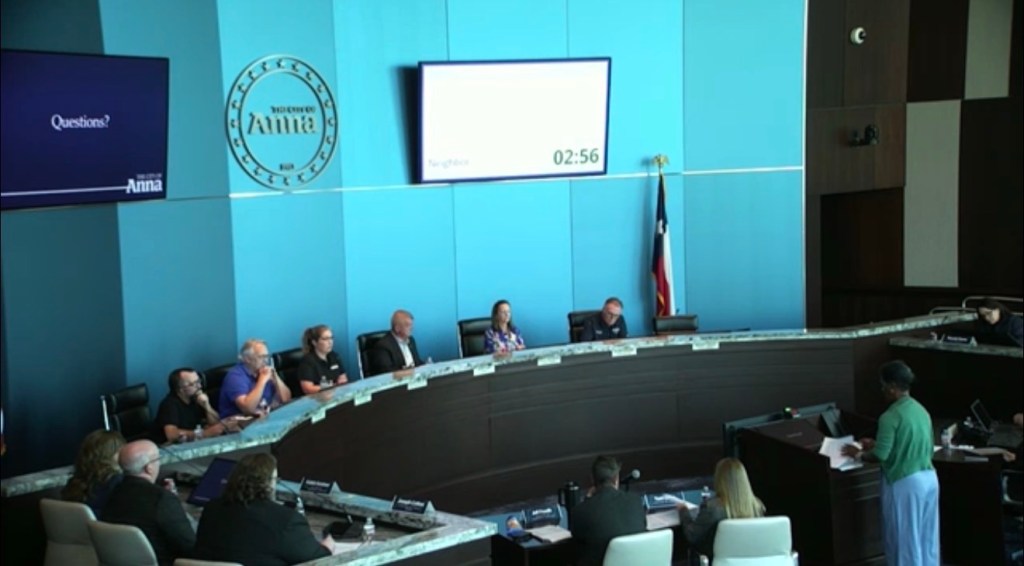
Two Anna residents spoke during the public hearing, arguing that homeowners are increasingly being asked to absorb rising costs.
Carol Spencer acknowledged that the city faces many of the same rising costs as individual households, but argued that homeowners ultimately bear much of the burden. She also questioned the balance between asking residents to pay more while offering incentives or concessions to businesses and developers.
“The burden always rolls downhill to that last stop,” Spencer said.
Todd Merka followed with a more direct request.
“I’m asking you not to raise the property tax,” Merka said. “Our property taxes are already too high.”
Merka said the total tax bill for his home, which sits on a 0.138-acre lot, was $7,934.98, including his Public Improvement District assessment and after accounting for his homestead exemption.
“This is over $660 a month,” Merka said. “For us this is entirely too much for a household with an ordinary income.”
Merka also questioned the burden of paying school district taxes despite having no children enrolled in Anna ISD.
Council Weighs Tax Burden Against City Needs
Councilmember Elden Baker argued that falling property values could result in some homeowners paying fewer dollars despite the higher rate.
“Most people are gonna see a lower dollar amount even though the rate is going up because home values went down a lot,” Baker said.
Councilmember Jessie Walden asked what the city would have to sacrifice without the additional property tax revenue.
Doby said debt obligations must be paid first, meaning reductions would fall on operations. Employee raises and step increases for public safety personnel would be among the first items affected, followed potentially by vacant positions.
Mayor Cain characterized the proposed rate as necessary to maintain existing services.
“It is the bare minimum to keep us where we’re at,” Cain said.
Toten also pointed to Anna’s ability to retain public safety employees.
“I know for a fact that our city is in the bottom of the bottom of the pay rate for our fire,” Toten said. “We’ll lose our good men to other cities in police and fire.”
Walden said council had also reduced expenses associated with travel, training and food.
“City Council has also come together as a team and decided, what do we not need? Where do we trim the fat?” Walden said.
For now, council is left to mull a difficult equation: how to fund the infrastructure and services demanded by Anna’s growth without placing an increasingly heavy burden on the residents already here.
The city enters fiscal year 2027 with major roads still unfinished, a wastewater system requiring significant new investment and public safety departments competing for employees. At the same time, residents at the special meeting made it clear that even relatively small increases matter when added to the broader cost of owning a home in Anna.
Meeting screenshots and presentation graphics obtained from the City of Anna’s Sept. 1, 2026 City Council special meeting broadcast.

